
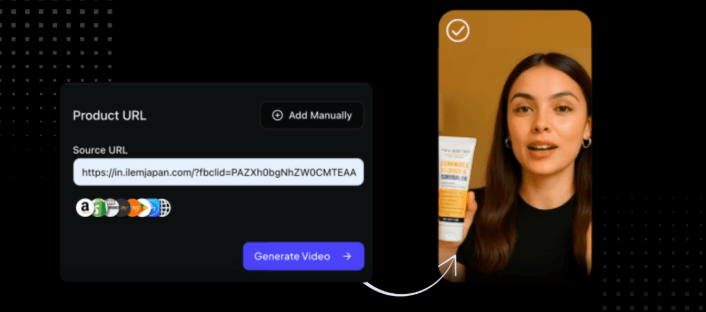
Video isn’t just a “nice-to-have” — it’s a sales-driving necessity. As consumer attention spans shrink and the demand for visual-first content skyrockets, brands are turning to a powerful, fast-moving solution: turning product URLs into AI-generated videos.
But is it all hype? Not at all.
From startups to global giants, e-commerce brands are seeing measurable return on investment (ROI) using AI to auto-generate video content directly from product URLs. These tools pull in product titles, images, prices, and reviews and turn them into short, eye-catching videos perfect for social ads, emails, PDPs (product detail pages), and more.
Here are five real-world ROI examples showing how AI-powered product-to-video workflows are helping brands sell smarter, faster, and better.
1. D2C Skincare Brand Boosts ROAS by 42% with AI Product Videos
Brand Type: Mid-size Direct-to-Consumer (D2C) skincare line
Challenge: High ad fatigue and low engagement on static creatives
Solution: Implemented AI-generated videos from product URLs for paid social
This skincare brand was facing declining click-through rates and low engagement on static Facebook and Instagram ads. They began using an AI tool that transformed their product URLs into 15-second, UGC-style videos with voiceovers, ingredient highlights, and testimonials.
After switching 80% of their static product creatives to AI video ads:
- ROAS improved by 42% in just four weeks
- CPC dropped by 31%, thanks to improved engagement
- Time-to-launch for new ad creatives dropped from 3 days to 30 minutes
Takeaway: Personalized, AI-generated video breathed new life into tired ad formats — without requiring an expensive shoot or agency.
2. Fashion Retailer Sees 60% Increase in PDP Conversion Rate
Brand Type: Multi-brand online fashion marketplace
Challenge: Low conversion rates on product detail pages
Solution: Added AI-generated product explainer videos to PDPs
With thousands of SKUs and limited product descriptions, this fashion marketplace saw most visitors bounce after a few seconds on PDPs. They integrated auto-generated videos (made from product URLs) that showcased clothing fit, fabric feel, and styling suggestions.
Results after a 3-month A/B test:
- 60% increase in PDP conversion rate
- 24% longer time spent on pages with videos
- 38% higher likelihood of adding to cart after watching a video
Takeaway: Shoppers don’t just want to read about your product — they want to experience it. AI videos help bridge the gap between product and decision.
3. Home Goods Brand Cuts Production Time by 90% and Doubles Email CTR
Brand Type: Furniture and home decor brand
Challenge: Email creatives took too long to produce and test
Solution: Used AI to instantly create product showcase videos from URLs
This brand was sending weekly promotional emails with static banners, but click-through rates were underwhelming. Their marketing team adopted a product URL-to-video tool that let them auto-generate themed videos for email headers and product highlights.
Impact after two months of integration:
- Email CTR doubled (from 3.2% to 6.5%)
- A/B test showed video-based emails had 37% higher revenue per email
- Creative turnaround time dropped from 5 days to under 1 hour
Takeaway: Email needs fresh, dynamic content to stand out. AI video lets you deliver that, weekly, without bottlenecks.
4. Electronics Brand Achieves 300% Engagement Spike on TikTok with AI UGC
Brand Type: Consumer electronics startup targeting Gen Z
Challenge: Scaling content production for TikTok and Reels
Solution: Generated TikTok-style unboxing and feature demo videos using product URLs
Competing with lifestyle influencers and tech reviewers, this electronics brand struggled to produce enough organic-looking video content. They began using AI to auto-generate TikTok-style videos — complete with voiceovers, on-screen text, emojis, and effects — using only product links.
Within six weeks:
- TikTok engagement jumped 300%
- Cost-per-view dropped by 61%
- Several AI-generated videos went viral, generating over 250K views each
Takeaway: TikTok moves fast — AI video tools let brands create native-looking content at scale, in minutes.
5. Luxury Jewelry Brand Scales Global Campaigns Without Losing Brand Voice
Brand Type: High-end global jewelry retailer
Challenge: Needed consistent, high-quality video content for international markets
Solution: Used AI to auto-generate on-brand videos from product URLs in multiple languages
For global product launches, this brand needed consistent video ads localized for different markets. Rather than shoot separate videos, they used AI tools to generate multilingual video creatives using URLs from their product catalog, with brand-safe colors, fonts, music, and voiceovers.
Campaign outcomes:
- Created 1,200+ localized videos in 5 days, saving weeks of production time
- Cost per localized video dropped by 92%
- Maintained brand voice and visual identity across regions
Takeaway: AI product video generation isn’t just fast — it’s scalable, brand-safe, and global-ready.
Why This Works: The Psychology Behind Video ROI
Why do product URL-to-AI videos work so well?
- Visual storytelling: Humans process video 60,000x faster than text, and videos build trust faster than static images.
- Emotion sells: Videos evoke emotion, urgency, and desire — all critical drivers of conversion.
- Mobile-first reality: Most shopping is done on mobile, and video fits mobile screens better than long descriptions or galleries.
- UGC mimics peer recommendations: AI-generated videos can simulate UGC formats, which outperform branded content in many A/B tests.
The Bottom Line
E-commerce is a visual game, and AI tools that convert product URLs into scroll-stopping videos are giving brands a serious edge. Whether it’s for paid ads, PDPs, email, or social media, these tools not only save time and money but also drive real ROI.
The future of e-commerce content isn’t just automated. It’s intelligent, scalable, and video-first — and it starts with something as simple as a product URL.
Ready to turn your product pages into performance-driving videos? The tools are out there, and your competition may already be using them.
Let the product pages speak. Let the AI do the rest.

 Social Widget